
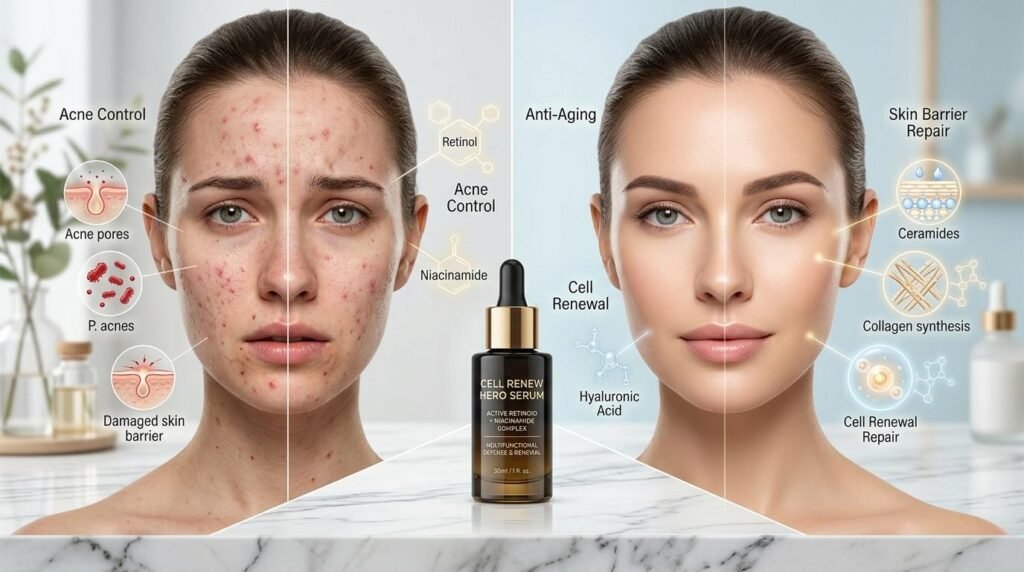
“I need something for my acne, but also something that targets signs of ageing. Can I get it within one ingredient?” The answer is yes, you definitely can.
Do you know that one ingredient we trust for acne and ageing? Retinol it is. Let us see why.
What is Retinol?
It is a form of vitamin A. Retinol is an ingredient added to skin creams, lotions, and serums. It can help clear acne and has anti-ageing effects.
One can buy retinol over the counter (without a prescription) or visit their healthcare provider to discuss how retinol might best fit into their skincare routine. The provider may prescribe medications that contain higher concentrations of retinoids than over-the-counter medications.
What is Retinol For?
As we know, it is a derivative of vitamin A. It is used in skincare to promote cell turnover, stimulate collagen production, and treat acne. It acts as a powerful anti-aging agent, reducing fine lines, wrinkles, and hyperpigmentation while improving skin texture and tone. It is commonly found in over-the-counter creams and serums.
Here is what retinol can be used for:
- Retinol stimulates collagen and elastin production, which firms the skin and reduces the appearance of wrinkles.
- It helps unclog pores and reduces inflammation, decreasing acne breakouts.
- Accelerating cell renewal, it removes dead skin cells, leading to smoother, brighter, and more even skin tone.
- It helps diminish sun damage and dark spots by accelerating skin turnover and curbing melanin production.
There are more uses of retinol. Let us see what benefits it can provide if you have acne or if you want to deal with signs of ageing.
Retinol and Acne: Can It Help?
Retinol is highly effective at helping treat and prevent acne by unclogging pores, reducing oil, speeding up cell turnover, and curbing inflammation.
As a vitamin A derivative, it clears existing pimples, reduces blackheads or whiteheads, and minimizes acne scars. It works best with consistent, long-term use and often takes several weeks or months to show significant results. Here is more information:
- Accelerates cell turnover to prevent dead skin cells and oil (sebum) from building up and blocking pores.
- Decreases the redness and swelling associated with breakouts.
- Helps improve the appearance of acne marks and dark spots.
- Regular use keeps pores clear, stopping new pimples from forming.
For acne-prone skin, begin with a low-strength, over-the-counter (OTC) retinol to minimize irritation. For nighttime use only, as sunlight can degrade retinol and make skin sensitive.
Retinol and Ageing: How Does It Help?
It is a top-tier anti-ageing ingredient that combats ageing by accelerating skin cell turnover, stimulating collagen production, and enhancing skin texture. It reduces fine lines, wrinkles, and hyperpigmentation while improving elasticity, resulting in a firmer, smoother, and more radiant complexion.
Here is how retinol combats ageing:
- Retinol stimulates the production of collagen and elastin, which thickens the dermis, improves skin elasticity, and fills in wrinkles and fine lines.
- It boosts the renewal process of skin cells, replacing old cells with new ones faster, leading to a smoother skin texture.
- It helps fade sunspots, age spots, and uneven pigmentation, resulting in a more uniform skin tone.
- By encouraging surface cell exfoliation, it unclogs pores and diminishes their appearance, leading to smoother skin.
- Retinol helps neutralize free radicals in the middle layers of the skin, protecting it from further environmental damage.
It is also necessary to learn whether retinol is good for your skin.
Is Retinol Good for My Skin?
Whether retinol is good for your skin or not depends on various factors. People who have sensitive skin and are often allergic to skincare products need to be more careful when using retinol.
It is a powerful tool against ageing skin and acne, but it is not for everyone. If the skin is prone to allergies or is sensitive, you might want to try skincare products with alternative anti-ageing or skin-clearing ingredients.
Essentially, it makes your skin more sensitive to sunlight, so be sure to use sunscreen and avoid the sun as much as you can while you use retinol products.
You need to start slowly with a pea-sized amount of low-concentration formula twice a week at night, gradually increasing frequency as tolerated, if you want to incorporate retinol in the skincare routine. But before applying it, use a gentle cleanser for clean skin.
If you want to use retinol cream, use a pea-sized amount of it at night on clean, dry skin, avoiding the eyes and mouth. A patch test is always the safest option to learn about the product and skin tolerance.