
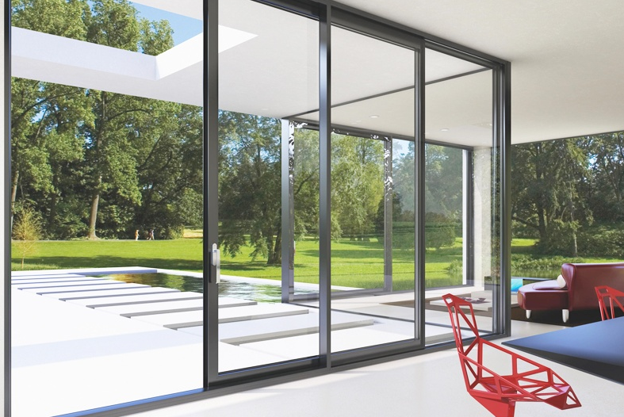
There is a habit people fall into without noticing: living with a hinged External sliding doors. The door stays shut more than it needs to. Opening it means committing to the swing, stepping around it, remembering to close it again before the room loses its warmth. Nobody decides this on purpose. It just becomes the pattern over time. What is interesting about switching to a sliding door is not really the door itself. It is how quickly that old pattern disappears once the friction of opening it is gone. External sliding doorschange behaviour in a house more than they change the wall they sit in, and that shift is the part most people never see coming until they are already living with one.
The Swing Arc Was Costing You Space You Never Noticed
All hinged doors have an invisible tax. It requires a curved section of floor space to swing into, a space that cannot be furnished and cannot be crossed freely. Just there, waiting for a door that might open or shut at any moment. Most people never consciously register this lost space, because it has always been part of the way the room was arranged. Take that hinged door out and put in a sliding one, then try to furnish the space it once occupied, and the difference can be almost startling. External sliding doors hand back space no one was using but everyone was quietly working around. In a smaller room, or tight renovation, that reclaimed space is what makes the difference between a cramped-feeling room and one that finally feels right.
A Room Borrows Size From What It Can See
Large sliding glass panels perform a perceptual trick on a space that is unrelated to the room’s real proportions. When the barrier between inside and outside is one continuous sheet of glass rather than a series of framed openings, the eye begins to interpret the garden or deck beyond as part of the space rather than something seen through a window. That is why a tiny kitchen with a wide sliding door to a courtyard might appear more spacious than a bigger kitchen with little separate windows and a hinged door tucked into a corner. External sliding doors have a purpose closer to visual architecture than plain access. They give a space a feeling of size that it does not truly have on paper.
The Track Is Where Sliding External sliding doors Quietly Fail
Here is the part nobody discusses during the sales presentation. A sliding door’s weather performance resides almost completely in its track and seals, which is a very different problem from a hinged door’s easy compression seal. Sand and miscellaneous debris build their way into a track over months, sometimes silently, until External sliding doors begins dragging slightly or rain finds a passage past a seal that deteriorates steadily without anybody knowing. Homes confronting actual weather exposure require a system really constructed for that punishment, not a typical door that worked great in a showroom but was never tested against driving rain at an angle. This single aspect divides an installation that remains seamless for years from one that silently develops into a source of irritation nobody ever tracks back to its original cause.
Smoothness Is a Habit, Not a Permanent Feature
You get used to the satisfying glide of a new sliding door and expect it to remain that way forever, quietly setting yourself up for disappointment. Now and then the tracks must be cleared. Lubricate rollers occasionally. Don’t do it, and nothing will suddenly fail. Instead there’s a creeping stiffness that people get used to, without really noticing anything has changed. By the time someone finally says that the door slides with real effort now, they’ve usually forgotten that it ever moved any other way.
Not All Locks Are Doing the Same Job
A sliding door’s lock is often thought of as being similar to other door locks. It is not safe to make such an assumption. A multi-point system engaging over the whole length of the door resists force considerably differently from a single latch placed at one end of a large panel, and the difference between the two only becomes apparent under actual stress—exactly the worst time to find out which one was really installed.
Conclusion
The real attraction of external sliding doors has little to do with the mechanism itself. It’s the square footage quietly reclaimed, the feeling of proportions a room borrows from what’s outside it, and the small behavioural shift that happens when opening the door no longer feels like a minor chore. The key to keeping that appeal alive for years, rather than fading as neglected doors so often do, is getting the track maintenance and security hardware right.