
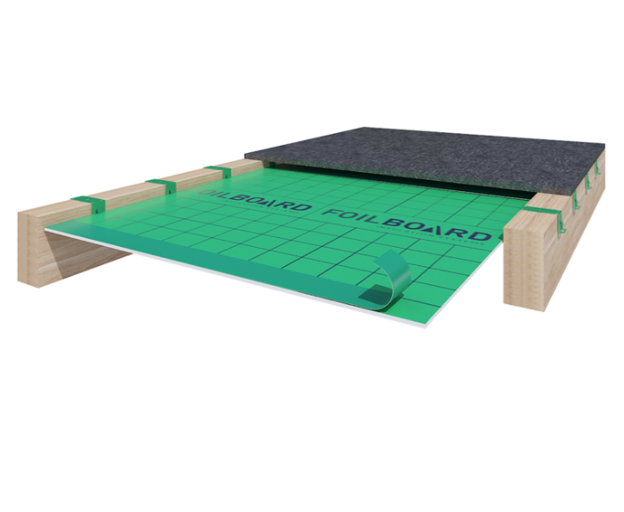
You may see why people are reconsidering how they insulate tiny buildings if you enter an unheated outbuilding in the winter. For sheds, lofts, and garden rooms, foilboard insulation is often suggested; however, most guidelines just mention that “it reflects heat” and omit the information that determines whether it is effective. Only a few circumstances allow the reflective layer to function. If you get things incorrect, you’ll have an expensive foam sheet that acts just like any other board.
What Foilboard Actually Is
Remove the marketing and foilboard, which is a closed-cell foam core with a metallized front that resembles aluminium foil and was selected for its resistance to heat flow. The purpose of such facing is not to increase strength. Instead of allowing the board to absorb and transmit radiant energy, its function is to bounce it back the way it came. Because the foam core does more work per inch of depth than mineral wool or loose-fill alternatives, builders seek for it in narrow stud walls and shallow loft voids. As a result, it is required in situations when tearing out a wall for thicker material is not an option.
Why the Air Gap Matters
Here’s the detail most product listings skip: foil only reflects radiant heat when it faces an open air gap. Screw plasterboard directly onto the foil, or push the board flush against blockwork with no space behind it, and the reflective property stops functioning. What’s left is the foam doing conductive work alone, which is far less effective. Anyone fitting foilboard against solid masonry without battening out a gap first is paying for a feature they’ve disabled before it gets used.
Where It Performs and Where It Fails
This disparity is seen in roof applications. Foilboard, which is installed under rafters with a vented space above, significantly reduces heat loss through the roofline. With little ventilation and a tight fit against sarking felt, moisture is trapped against the wood with nowhere to dry out, causing rot to develop before anybody notices. Specifiers see the gap as part of the system rather than an optional addition since the identical board fitted in two distinct ways yields different results.
Getting the Installation Right
Cutting and fixing the board is straightforward, which is part of why people underestimate what isn’t. Sealing the joints is where most amateur jobs go wrong. Ordinary tape softens and lifts under temperature swings, opening gaps that let cold air track through the barrier at every seam. Proper foil tape, pressed firmly and given time to bond, keeps the reflective surface continuous across the structure. Skip that step and every joint becomes a weak point, regardless of how good the boards themselves are.
The Moisture Question
Older buildings with solid walls don’t behave like modern timber-frame structures, and treating foilboard the same way in both is where things go wrong. Foilboard insulation is vapour-closed by nature, so fixing it to a solid wall that relies on breathing through its fabric can trap dampness behind the board instead of letting it escape. That trapped moisture eventually shows up as mould or blown plaster, often after the installer has moved on. Anyone working on a period property needs to think about where moisture travels before deciding where the board goes.
Picking the Right Core
Not every foam core behaves the same way under load or moisture, and the difference matters more in floors than walls. A core meant for vertical fixing can crush or deform under foot traffic if used beneath flooring instead. Foilboard insulation suited to a roof void won’t necessarily suit a damp floor build-up, which is why matching core type to application avoids problems that only become obvious once the floor feels soft underfoot.
Final Thoughts
None of this makes foilboard a poor material choice. It makes it a material that rewards attention to detail in a way thicker, more forgiving insulation doesn’t. Foil board insulation works well when the air gap is respected, the joints are sealed properly and the core suits the job, but skip any of those steps and the gap between “fitted” and “fitted correctly” becomes obvious fast. Anyone weighing it up should ask an installer about gaps and tape before asking about anything else.